

United airlines flight ua770 emergency diversion
Executive Summary
On June 29, 2023, united airlines flight ua770 emergency diversion from Lisbon, Portugal, to Newark, New Jersey, became the focus of a dramatic mid-air emergency. Approximately three hours into the flight, the Boeing 767-300 aircraft experienced a critical failure of its primary hydraulic system, a vital component for controlling the aircraft’s flight surfaces. Following the checklist for a “Red Hydraulic System Eject” warning, the crew was forced to declare an emergency (Pan-Pan) and execute a controlled diversion to Lajes Field (TER/LPLA), a former U.S. Air Force base in the Azores archipelago, Portugal. The incident, which resulted in no injuries to the 174 passengers and 10 crew members, highlights rigorous pilot training, the importance of strategic emergency airfields, and the ongoing scrutiny of aircraft maintenance protocols.
1. Introduction: Routine Flight Interrupted
United airlines flight ua770 emergency diversion is a regular scheduled service connecting Lisbon’s Humberto Delgado Airport (LIS) to Newark Liberty International Airport (EWR). On that Thursday afternoon, the aircraft, a 24-year-old Boeing 767-300ER (registered as N663UA), pushed back from the gate under clear skies, carrying 174 passengers bound for the United States. The takeoff and initial climb were uneventful. The flight crew settled in for the long overwater segment, governed by strict ETOPS (Extended-range Twin-engine Operational Performance Standards) protocols that dictate planned diversion routes.
However, as the aircraft cruised at 37,000 feet over the vast expanse of the North Atlantic Ocean, roughly 700 miles west of the Portuguese coast, the routine was shattered. An amber caution light illuminated on the cockpit’s overhead panel, quickly escalating to a more urgent master caution. The indication: a failure and subsequent automatic shutoff of the aircraft’s No. 1 (Red) hydraulic system.
2. The In-Flight Emergency: Systems Failure and Decision Point
The Nature of the Failure
Modern commercial jets like the Boeing 767 use multiple, redundant hydraulic systems to power essential flight controls—ailerons, elevators, rudder, flaps, slats, landing gear, and brakes. The 767 has three independent systems: Left (Green), Center (Blue), and Right (Red). The failure of the Red system represented a significant degradation of the aircraft’s control redundancy and affected specific functions, including one of two power sources for the rudder, alternate brakes, and leading-edge slats.
Following the failure, the aircraft’s centralized fault display system presented the crew with a specific checklist: “RED HYD SYSTEM EJECT.” This procedure is a memory item for pilots, requiring them to immediately confirm the system’s automatic shutoff valve has closed to prevent fluid loss and potential damage to the remaining systems.
The Crew’s Response
The cockpit crew, comprising a Captain and a First Officer, immediately engaged in disciplined Crew Resource Management (CRM). Their actions followed a clear hierarchy: Aviate, Navigate, Communicate.
- Aviate: They ran the “Red Hydraulic Eject” checklist, secured the failed system, and assessed the aircraft’s handling. The 767 is designed to be safely controllable with two hydraulic systems, but performance limitations apply.
- Navigate: With the failure confirmed, the crew needed to find a suitable diversion airport. They were over the ocean, outside the range of immediate return to Lisbon. Using their ETOPS planning charts and consulting with onboard navigation databases, they identified the nearest adequate airfield: Lajes Field (TER) on Terceira Island in the Azores.
- Communicate: The First Officer contacted Santa Oceanic Air Traffic Control on the high-frequency radio, declaring a “Pan-Pan” emergency—the international radio urgency signal indicating a serious situation that does not pose an immediate danger to life but requires priority handling. They communicated their intention to divert to Lajes.
The decision to divert to Lajes Field was strategic. While civilian airports were closer in the Azores (like Horta or Ponta Delgada), Lajes offered a significantly longer runway (over 10,000 feet), ample emergency services, and former U.S. military support infrastructure—a critical advantage for an aircraft landing with degraded systems.
3. The Diversion and Landing at Lajes Field
Preparing for Arrival
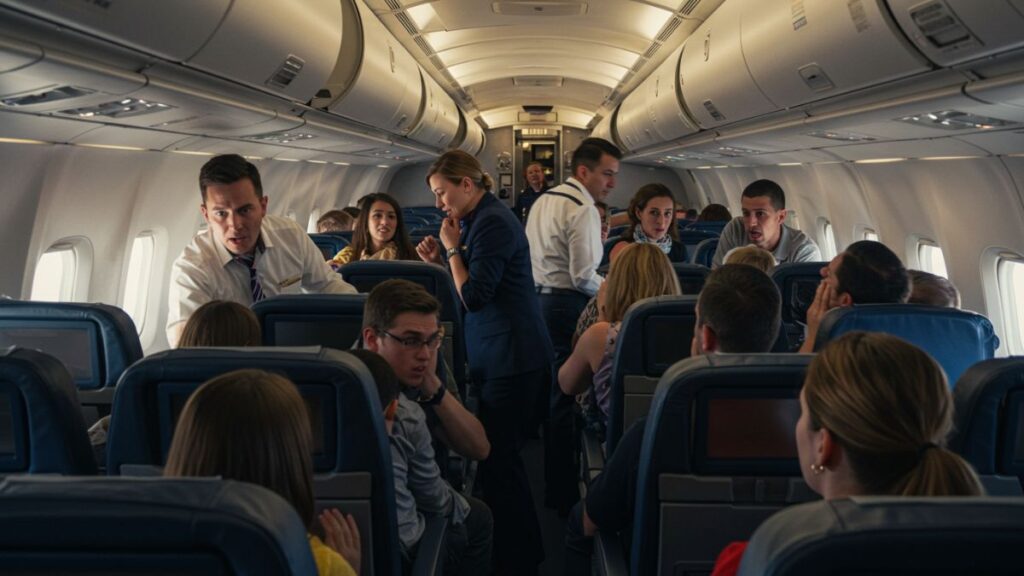
After declaring the emergency, Air Traffic Control cleared the flight for a direct route to Lajes, providing priority over other traffic. In the cabin, the lead flight attendant was briefed by the Captain. Passengers were informed of a “technical issue” requiring a precautionary landing and were instructed to prepare the cabin for arrival. The crew prepared for a potential emergency evacuation, reviewing door assignments and commands, though this was communicated as a standard precaution.
The pilots ran the “Two Hydraulic Systems” landing checklist, which involved reconfiguring the aircraft’s flight controls and verifying the functionality of the remaining Green and Blue systems. They planned for a flaps-limited landing, as the loss of the Red system affected leading-edge slats, requiring a higher approach speed.
The Landing
Approaching Terceira Island, the aircraft was met by emergency vehicles lining the long runway. The approach was stable, and at approximately 17:43 UTC, United Airlines Flight UA770 touched down smoothly on Lajes Field’s Runway 33. The pilots used alternate braking methods available through the remaining hydraulic systems, and the aircraft rolled to a safe stop on the runway. Emergency vehicles followed as the aircraft taxied to a remote parking stand under its own power. No evacuation was necessary.
4. Aftermath: Investigation and Implications
Passenger Care and Logistics
Once parked, passengers deplaned via air stairs onto the tarmac. United Airlines’ operational crisis team activated, working with local authorities at the Azores. With the aircraft Aircraft On Ground (AOG) and in need of inspection and repair, arrangements were made to accommodate the 184 souls. Passengers were initially transported to a local hotel. Given the remote location and the complexity of the repair, United eventually ferried a replacement Boeing 767 from the United States two days later, on July 1, to transport the passengers onward to Newark.
Official Investigation
The incident fell under the jurisdiction of the Portuguese Autoridade Nacional de Aviação Civil (ANAC) and the U.S. National Transportation Safety Board (NTSB), with technical support from Boeing. Preliminary findings focused on the cause of the Red hydraulic system pump failure. Maintenance records for the aircraft were scrutinized. While the final investigation report details are technical, the event underscored the importance of United airlines flight ua770 emergency diversion.
- Redundant Systems Design: The aircraft’s design to safely operate with one hydraulic system failed was validated.
- Pilot Training and Procedures: The crew’s textbook response was cited as a key factor in the safe outcome.
- ETOPS and Diversion Planning: The incident served as a real-world validation of ETOPS diversion procedures over the North Atlantic.
5. Technical Deep Dive: Boeing 767 Hydraulic Systems
To understand the seriousness of the situation, a closer look at the B767’s hydraulics is needed:
- System Architecture: The three systems are physically separated and powered by different sources: engine-driven pumps, an electric pump, and a ram air turbine (RAT) that can deploy in emergencies.
- Consequences of a Red System Loss: The failure affects the autospoiler system, alternate brakes, the No. 1 thrust reverser, and half of the leading-edge slats. Landing flap settings and approach speeds must be adjusted accordingly.
- Checklist Philosophy: The “Eject” checklist is designed to isolate the failure, preserving fluid and pressure in the remaining two systems—a classic example of aviation’s “fail-operational” or “fail-safe” design philosophy.
6. Conclusion: A Textbook Case in Modern Aviation Safety
The emergency diversion of United airlines flight ua770 emergency diversion did not make headlines for a tragic outcome but for a successful one. It stands as a compelling case study in modern aviation safety, demonstrating the effective interplay of:
- Robust Aircraft Design: Engineering redundancy that contained a major system failure.
- Superlative Crew Performance: Highly trained pilots executing procedures under pressure with flawless CRM.
- Effective Regulatory Frameworks: ETOPS rules that ensure no point on a transoceanic route is too far from an adequate airfield.
- Coordinated Emergency Response: Seamless coordination between the flight crew, ATC, and ground services at Lajes.
The incident concluded not with fanfare but with the quiet resolution that defines aviation safety’s highest goal: a serious in-flight emergency handled so proficiently that it became, for the passengers, an extended travel delay rather than a disaster. It reaffirmed a core truth in aviation: while technology can fail, a layered, human-centric safety culture is the ultimate guarantor of safe passage.